Cut lists, shopping lists and cutting plans
Mortise reads the cut list off the model: every part to saw at its finished size, the boards and sheets to buy at the lengths a yard sells them, the hardware by count and size, and the tools the work needs. Nothing is typed in by hand, so it is always the piece you drew.
Updated
Open the cut list
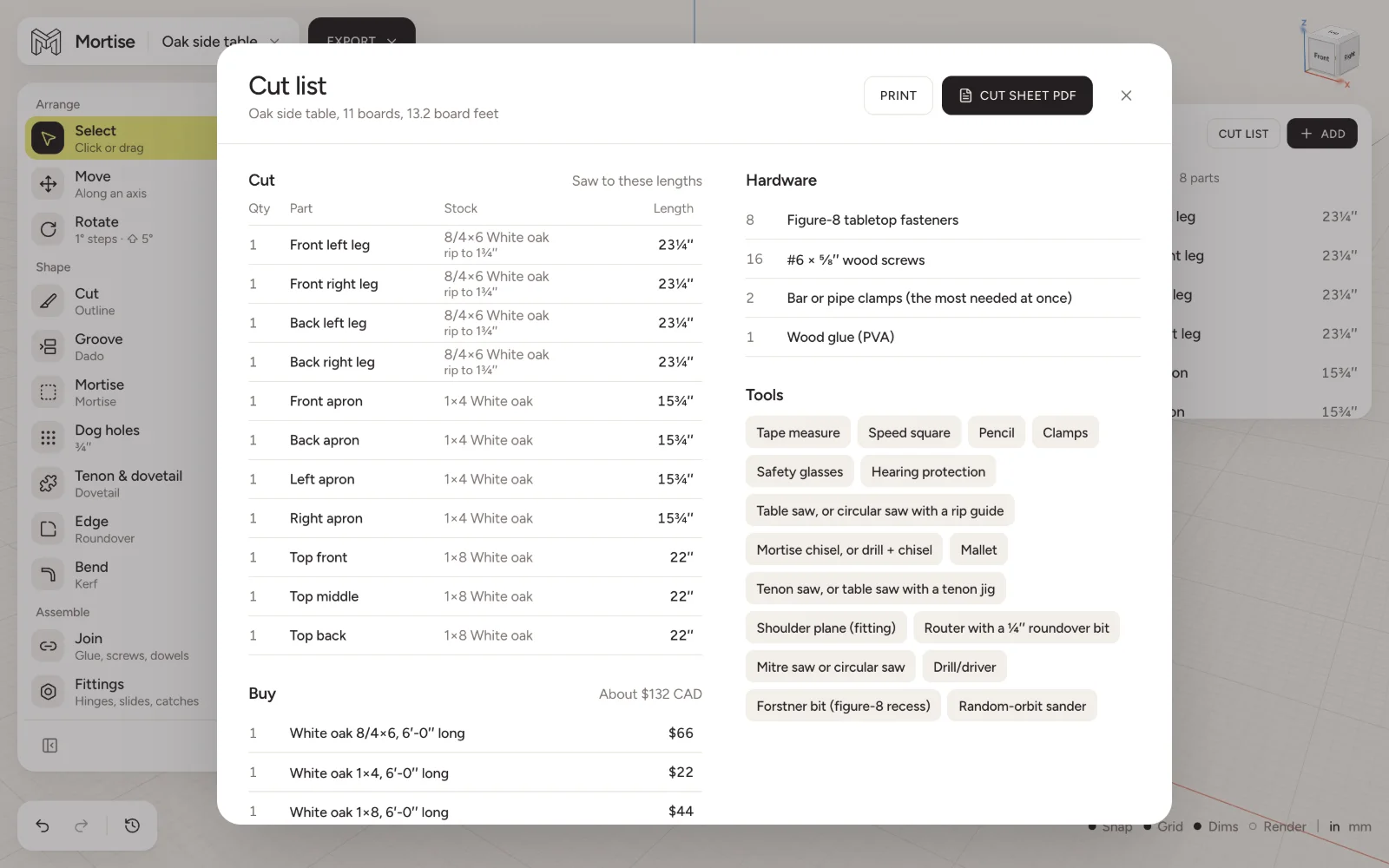
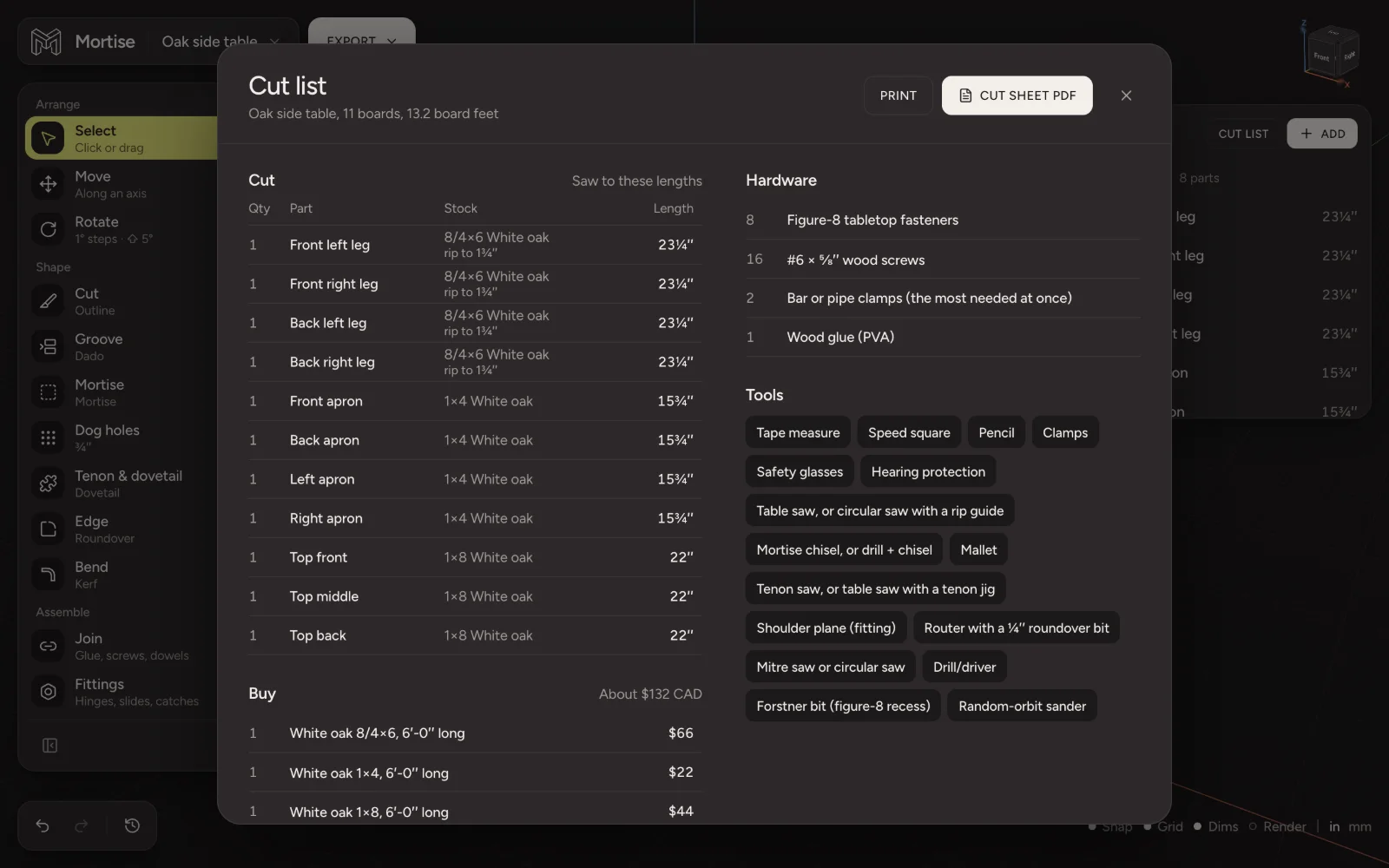
Press Cut list in the Parts panel. The title gives the project, how many boards and the board feet (or cubic metres) of wood. Print prints it; Cut sheet PDF makes the printable cut sheet.
Cut: saw to these lengths
Each part with its Qty, Part name, Stock and Length. Identical parts are counted together. The stock column says what to start from and how to mill it, in order: rip to a width, resaw or plane to a thickness, a taper.
Reference parts (walls, appliances, things already built) are left out.
Buy: what to bring home
The boards and sheets to buy, with a rough price for each and a total. Boards are bought at standard lengths, 6 to 16 feet or 2400 to 5400 mm, and parts are packed into them by crosscutting blocks and ripping them side by side, picking the cheapest way. Sheets are bought whole.
- Every saw cut is allowed ⅛ inch (3 mm) for the kerf, and each board ½ inch (10 mm) of end trim.
- A part longer than the longest stock, or one that does not fit a sheet with its grain the way you drew it, is called out.
- Prices are rough Canadian retail, per board foot for lumber and per sheet for sheet goods, to estimate a budget. A veneered sheet costs more by its face: walnut faced ply about 1.85 times birch.
Hardware
Every fastener and fitting in the model, counted by kind and size: wood screws by gauge and length, pocket-hole screws, dowels, biscuits and Dominos, bolts with their nuts and washers, cleats, tabletop clips, hinges, slides and their mounting screws. Wood glue is listed when anything is glued, and the clamps it needs: the most needed at once.
Tools
The tools the work calls for, worked out from the operations in the model. A tape measure, square, pencil, clamps and eye and ear protection are always there; a mitre saw, a bandsaw with a resaw fence, a pocket-hole jig, a doweling jig, a router or a hinge jig join them when a part needs one.
The cutting plan
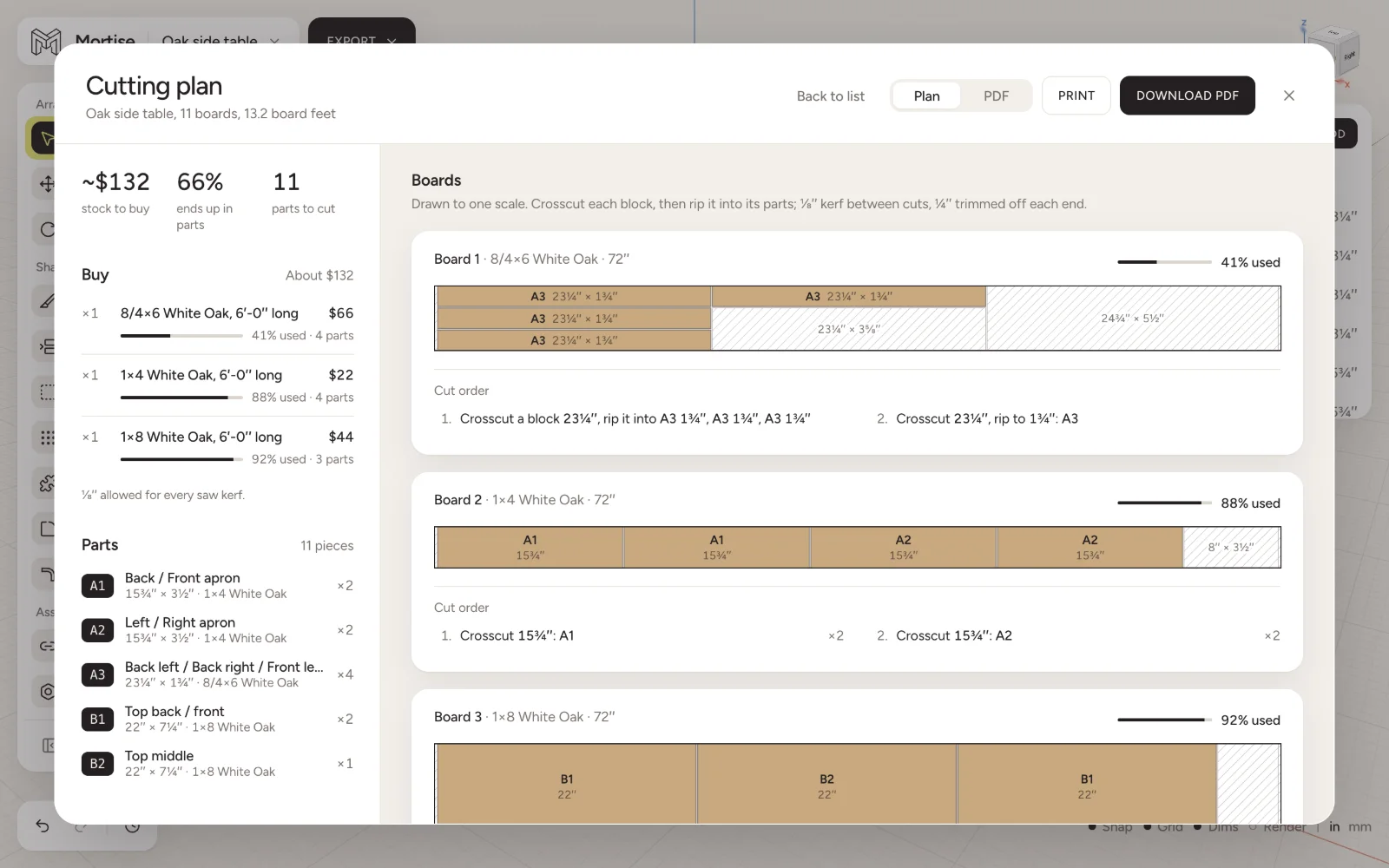
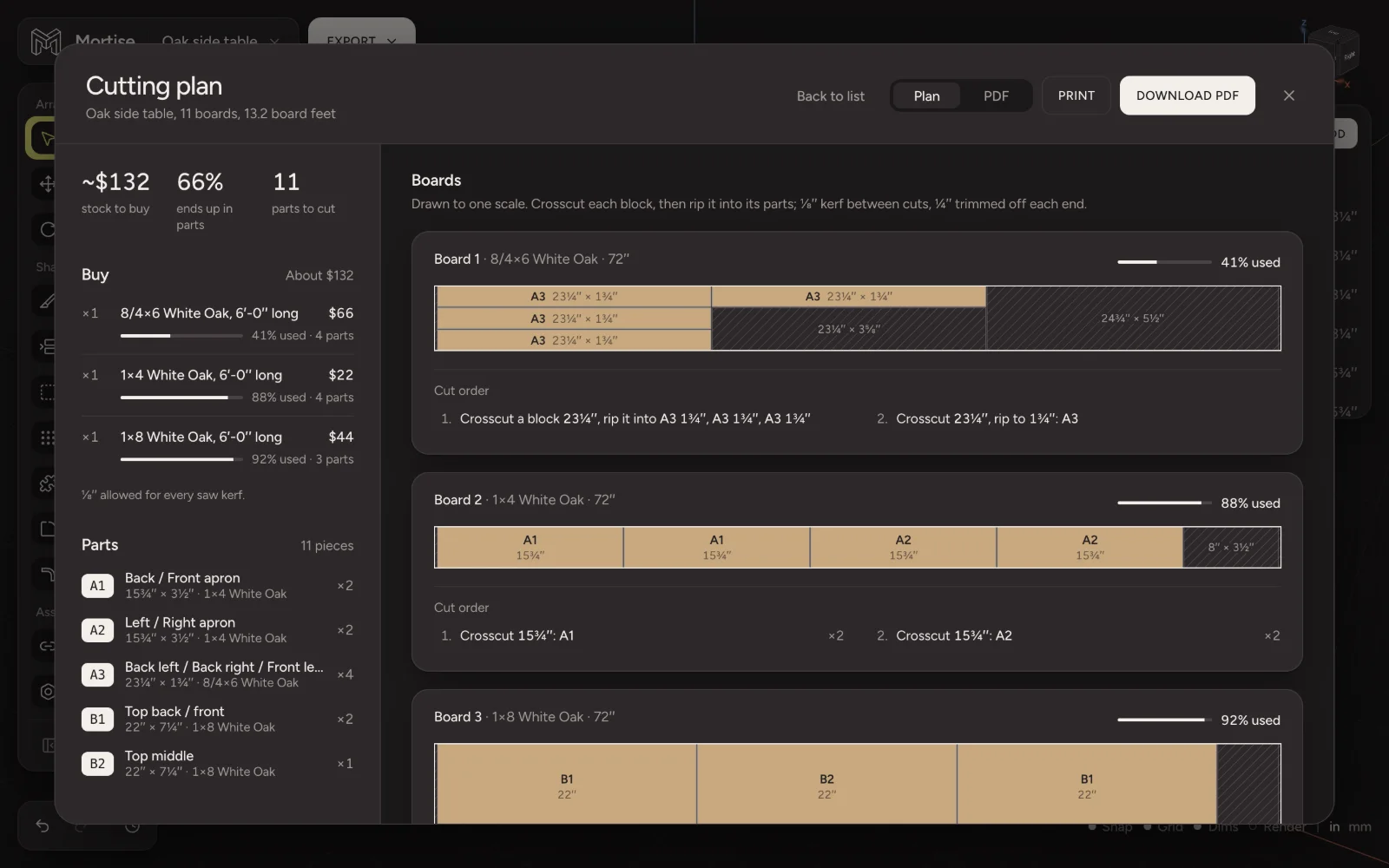
Export › Cutting plan is Mortise’s cut list optimizer: it lays every board and sheet out with the parts in it, to cut with the least waste. The side bar says what the stock costs, how much of it ends up in parts, and how many parts there are. Each board and sheet has numbered steps: crosscut here, rip there. Offcuts are hatched with their sizes. Point at a part to light every copy of it. Switch Plan to PDF to print it.
Questions
- Does Mortise make a cut list automatically?
- Yes. The cut list, the shopping list, the hardware and the tools are read from the boards in the model and update as you draw.
- How does Mortise work out board feet?
- From the nominal size, the way a yard charges: a 2×4 counts as 2 by 4 inches. Metric projects count cubic metres of the actual section.
- Can I change the kerf or the prices?
- Not yet. The kerf is ⅛ inch (3 mm) and prices are rough Canadian retail, meant for an estimate.
- Does it optimise the cutting layout?
- Yes. Parts are packed into standard boards and sheets choosing the cheapest way, and the cutting plan shows the order to cut them in.