Dadoes, rabbets, grooves and laps
The Groove family G routes channels and steps into a face: across the grain (a dado or rabbet), along it (a groove or tongue), undercut for hardware (a T-slot or dovetail slot), or halfway through for a lap joint.
Updated
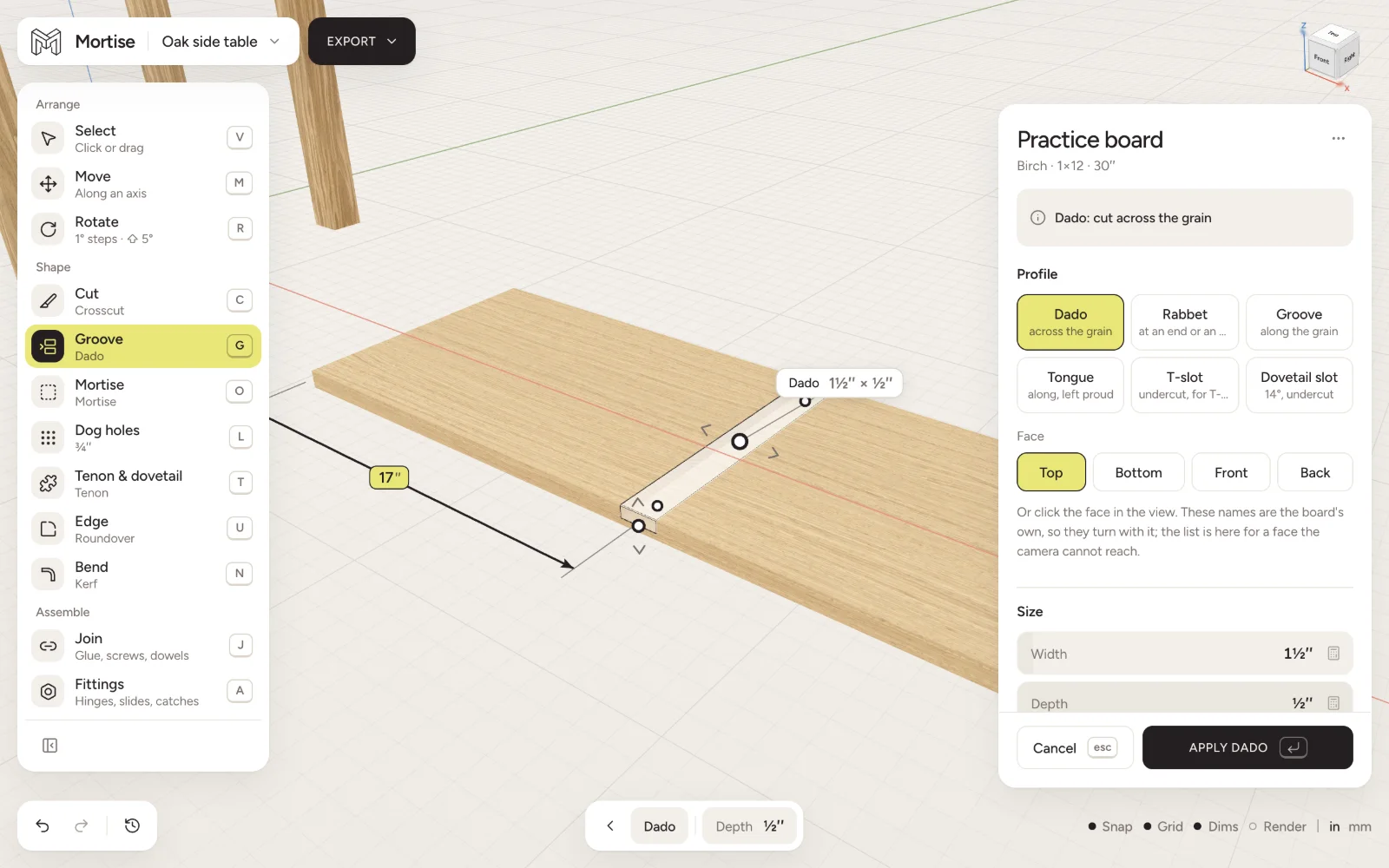
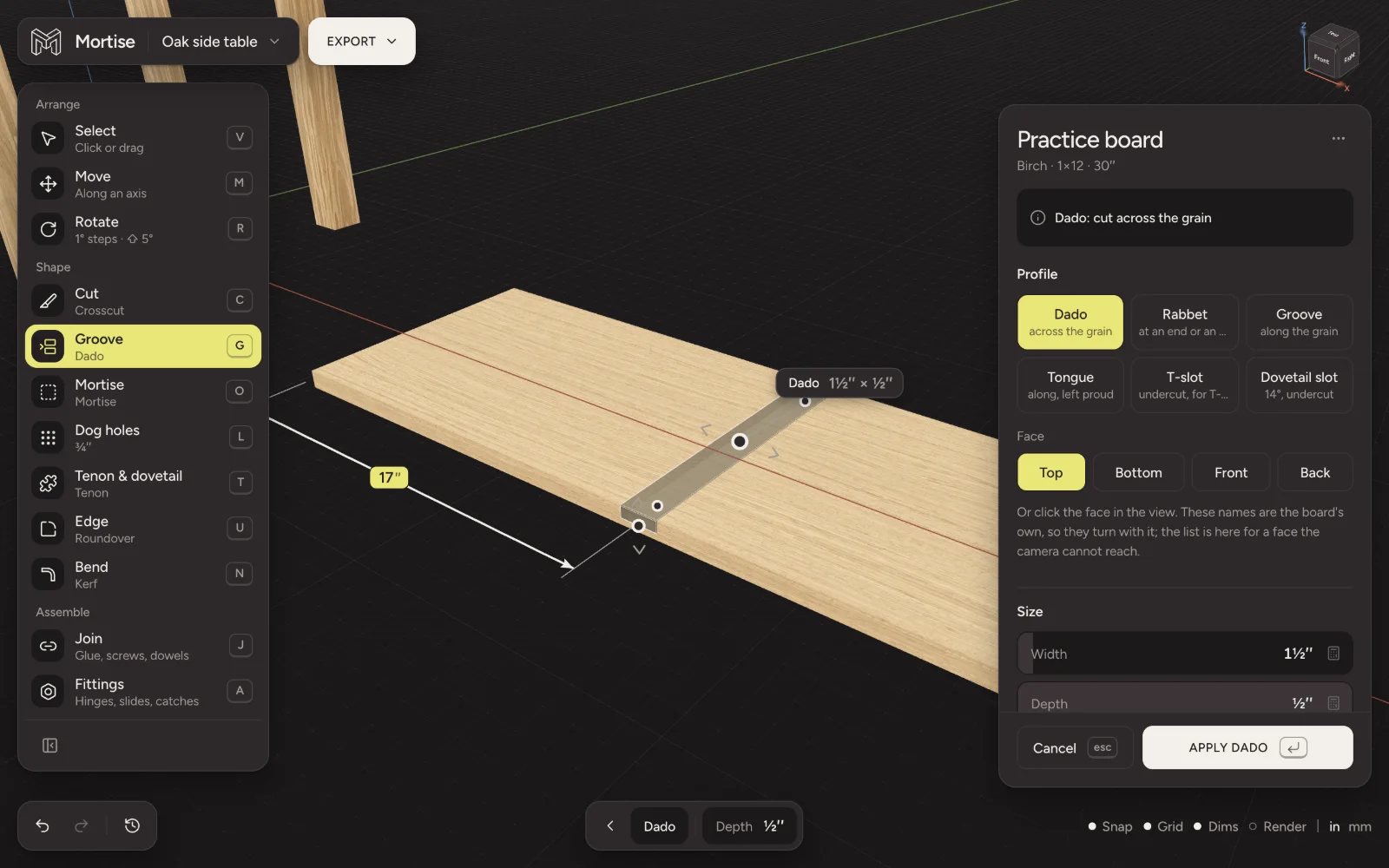
The modes
G opens the family and steps through the modes; P goes straight to Groove. A T-slot or dovetail slot keeps the direction of whatever was in hand. Half-lap and cross-lap start at the board’s width and half its thickness.
Cut a dado
- Press G and pick Dado. Move over the board: the face under the pointer lights up with the dado drawn on it.
- Click the face. The dado starts at the size you used last, or 1½ × ½ inch the first time.
- Set Width and Depth, and its Position from the left or right end. Drag a wall on the wood to widen it, or the depth puck to deepen it.
- Press Enter.
Set a board’s thickness as the width for a shelf that fits snug. Depth can go to two thirds of the stock. Stops hold the dado in from either edge for a stopped dado; 0 runs it out through that edge. A rabbet takes Which end instead of a position.
Grooves and tongues
A groove runs the length of the face you click, Off centre by as much as you set. It is the usual home for a drawer bottom or a frame-and-panel’s panel. A tongue is cut along an edge with a Thickness and how far it stands Proud, to fit a groove of the same width.
A rabbet along the grain picks its Edge rather than a face.
T-slots and dovetail slots
Both are routed with a bit wider below than at the face. Set the neck width (or the width at the face) and depth. Such a bit cannot plunge, so the slot has to run out of at least one edge: stop it at one end only.
Putting the joint together
A housing joint is the groove on one board and the other board placed in it. Move the shelf into its dado (it slides in along the faces) and join the two with glue. The glue covers the floor and walls of the dado. See Joining boards.
Questions
- What is the difference between a dado and a groove?
- In Mortise, as in most North American shops, a dado runs across the grain and a groove runs along it. A rabbet is a step at an end or an edge.
- How deep can a dado be?
- Up to two thirds of the board’s thickness. A third to a half is usual for a shelf.
- Can I make a stopped dado?
- Yes. Set the Stops in from either edge. T-slots and dovetail slots can be stopped at one end only.