Hinges, drawer slides and other fittings
Fittings are the hardware that lets one part of a piece move or come apart: hinges, drawer slides, lid supports, catches, brackets, knock-down connectors and shelf supports. Mortise reads where they go from the boards, drills them into the wood, checks that the door really swings, and adds them to the shopping list.
Updated
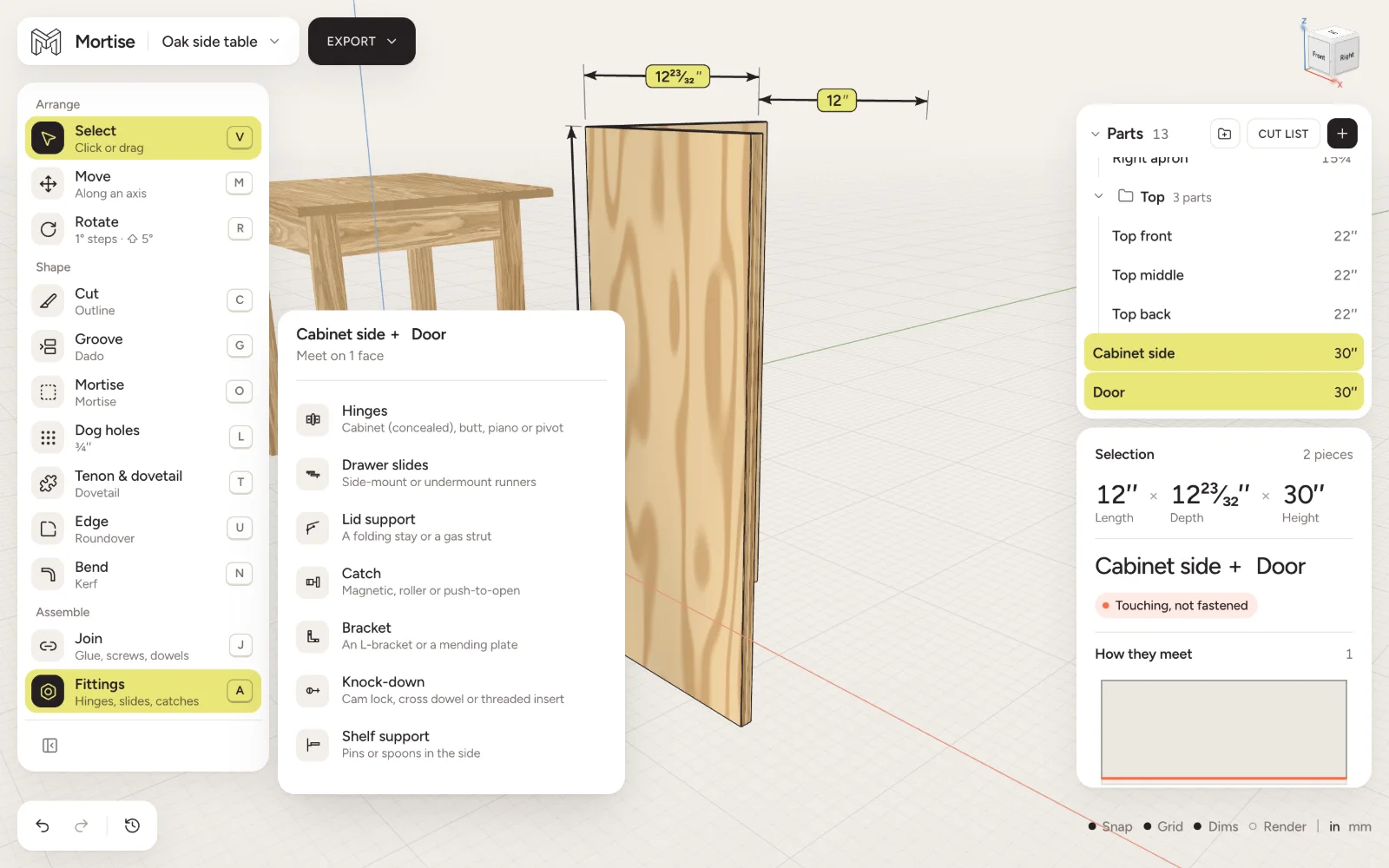
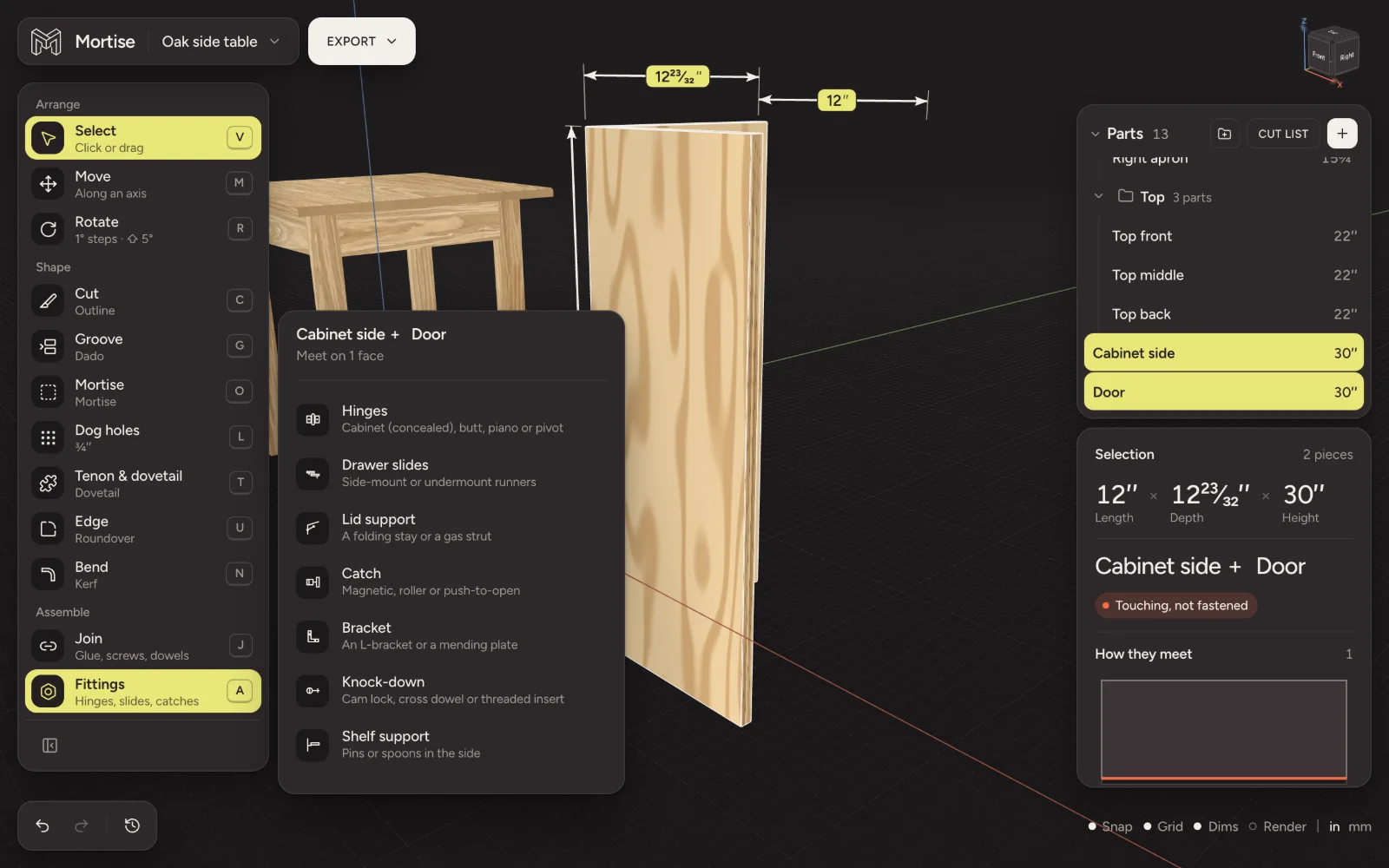
Fit hardware between two boards
- Click the board that stays put, such as a cabinet side, then ⇧-click the one that moves or rests on it: the door, drawer, lid or shelf.
- Press A, or Fittings in the tool column, and pick a family.
- Mortise suggests the style and place from how the boards stand. Change the type, the place or the count in the inspector.
- Press Fit to put it on.
The boards do not have to touch: a drawer slide spans the gap between a drawer and the carcase. For hinges Mortise works out which board is the door by which one can turn.
What there is
Hinges
A hinge place is offered only where the door, turned on its pin, swings a full quarter turn clear of the board it hangs from. If there is no such place, Mortise refuses the hinge and says why, rather than draw a door that could not open. Set the door where it closes, with its edge against the board it hangs from, or its back across that board’s front edge.
- Cabinet hinge
- A full-overlay concealed hinge with a 35 mm cup, for doors 16 to 24 mm thick. It opens to 110°. An inset door is refused: use a butt hinge.
- Butt hinge
- Leaves let into the door and the frame where the gap needs it, otherwise surface mounted. Opens to 180°.
- Piano hinge
- A continuous hinge along the edge, for lids and fall fronts.
- Pivot hinge
- A pin at the top and bottom, offset or centred.
Every hinge can be swung open to see the door move. The hinges menu lists each one, closed or open, with Open to, Close, Edit and Remove. Opening is a step on the history like any other.
The fitting panel
- Role
- Which board swings, slides, lifts or rests, with what it carries: “The door, which takes the cup; the side takes the plate.”
- Style
- Surface mounted or mortised, suggested by how the boards stand or chosen by hand.
- Where
- Read from the boards: which end the barrel sits at, which face the slide runs on, which edge the stay folds against.
- Hardware
- How many, Length, Width, Spacing, Screw length and Pilot diameter, each standard until you change it.
- Open
- A preview of the door or drawer opened. It moves nothing and checks nothing.
- Fit
- Whether the mounting screws and bores stay inside the wood, and how far the door swings clear.
- Adjust
- Nudge each half along, across or turn it.
In the shopping list
Each fitting is listed with its style and length, with the screws that mount it. The tools list gains what the hardware needs: a drill, a 35 mm Forstner bit and hinge jig for cabinet hinges, a router or chisel for mortised hinges.
Questions
- Why won’t Mortise put a hinge on my door?
- The door has to be able to swing a quarter turn clear of the board it hangs from. Set the door closed against the cabinet, its edge on the side or its back across the side’s front edge, and try again. Joins that hold the door rigid also stop it swinging.
- Does Mortise support inset cabinet doors?
- The cabinet hinge is full overlay. Hang an inset door on butt hinges, which are let into the door and frame.
- Can I add drawer slides?
- Yes: side-mount or undermount. Select the carcase side, then the drawer, press A and pick Drawer slides.