Tenons, box joints, bridles and dovetails
The Tenon & dovetail family T cuts joinery on the end of a board, or along a straight edge: tenons, box joints, bridles and dovetails. Each joint is cut one board at a time, and the second board starts out matched to the first.
Updated
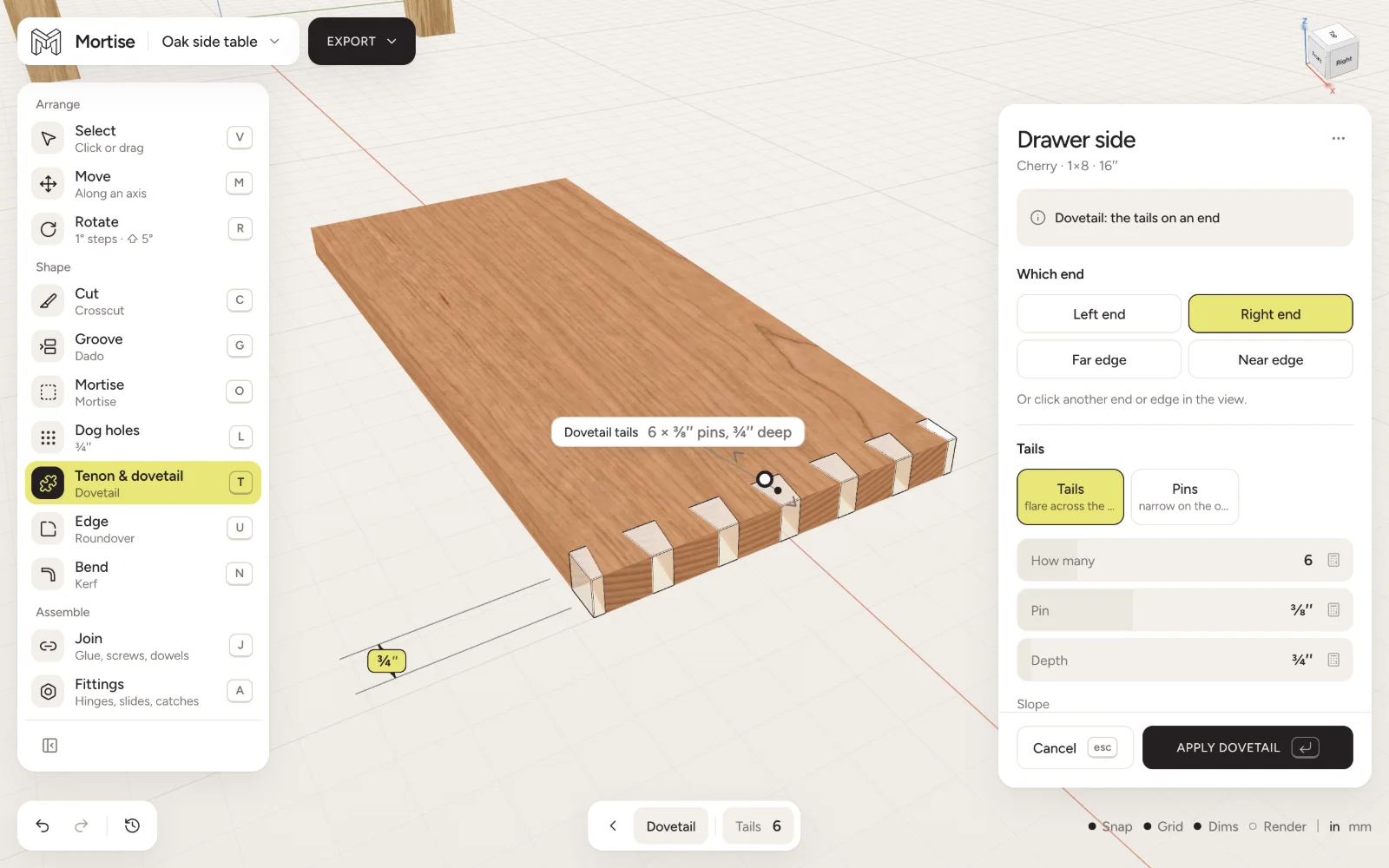
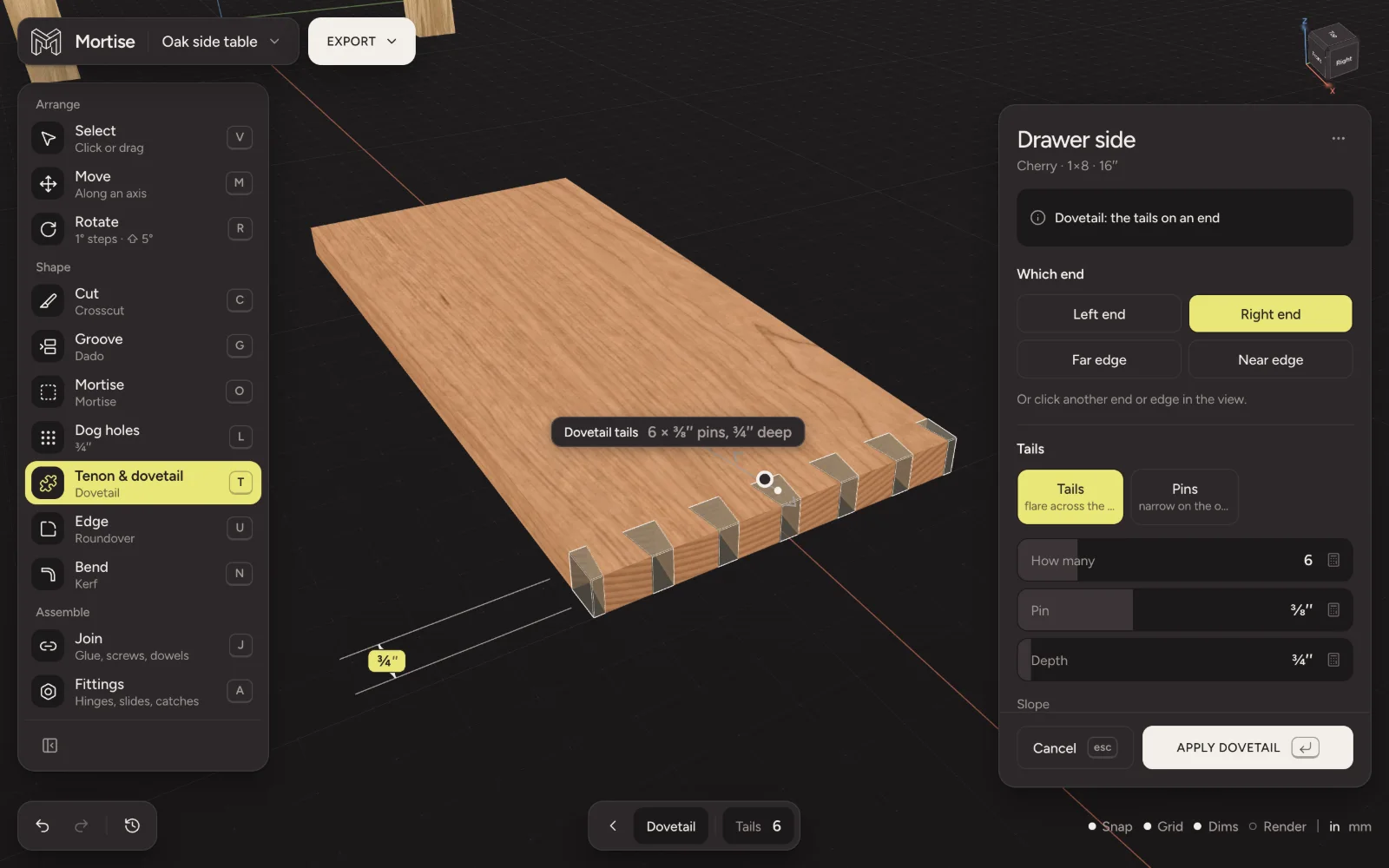
How end joints work
- Press T (or B box, K bridle, D dovetail). Move over the board: the nearer end or long edge lights up.
- Click it. The joint is drawn on that end with the waste in grey.
- Set the numbers on the bar or in the inspector, or drag the handles on the wood.
- Press Enter.
Which end switches between the left and right ends and the far and near edges. An edge takes a joint only where it is straight and square.
Tenon
The end is cut down to a tongue with shoulders all round. It starts a third of the stock thick, the width less a sixth each side, and 1 inch (25 mm) long.
- Tongue
- Thickness, Width and Length.
- Offset & angles
- Move the tongue off centre in either direction, angle the tongue with a miter or bevel, and angle the shoulders for a rail that meets a leg at a slant.
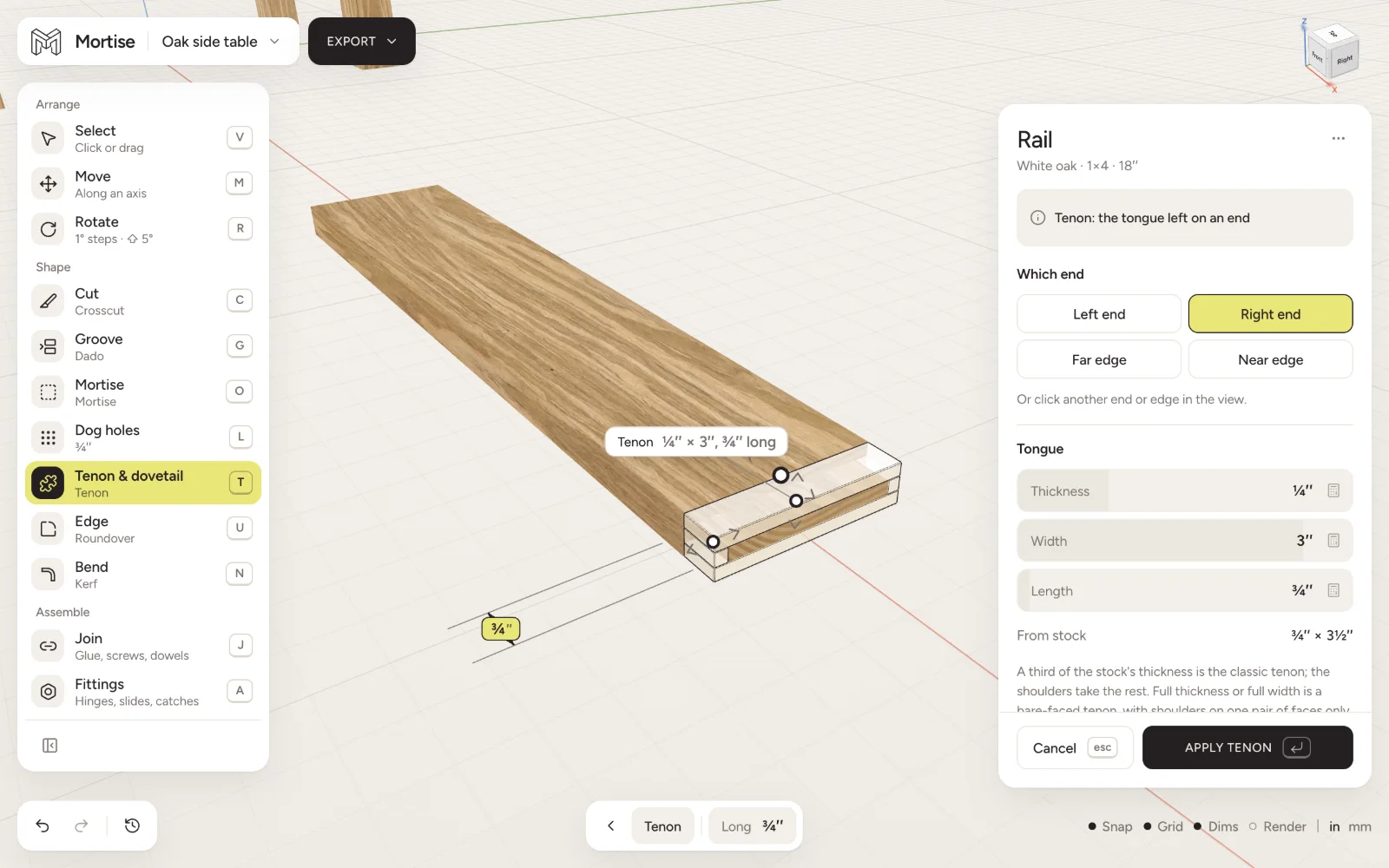
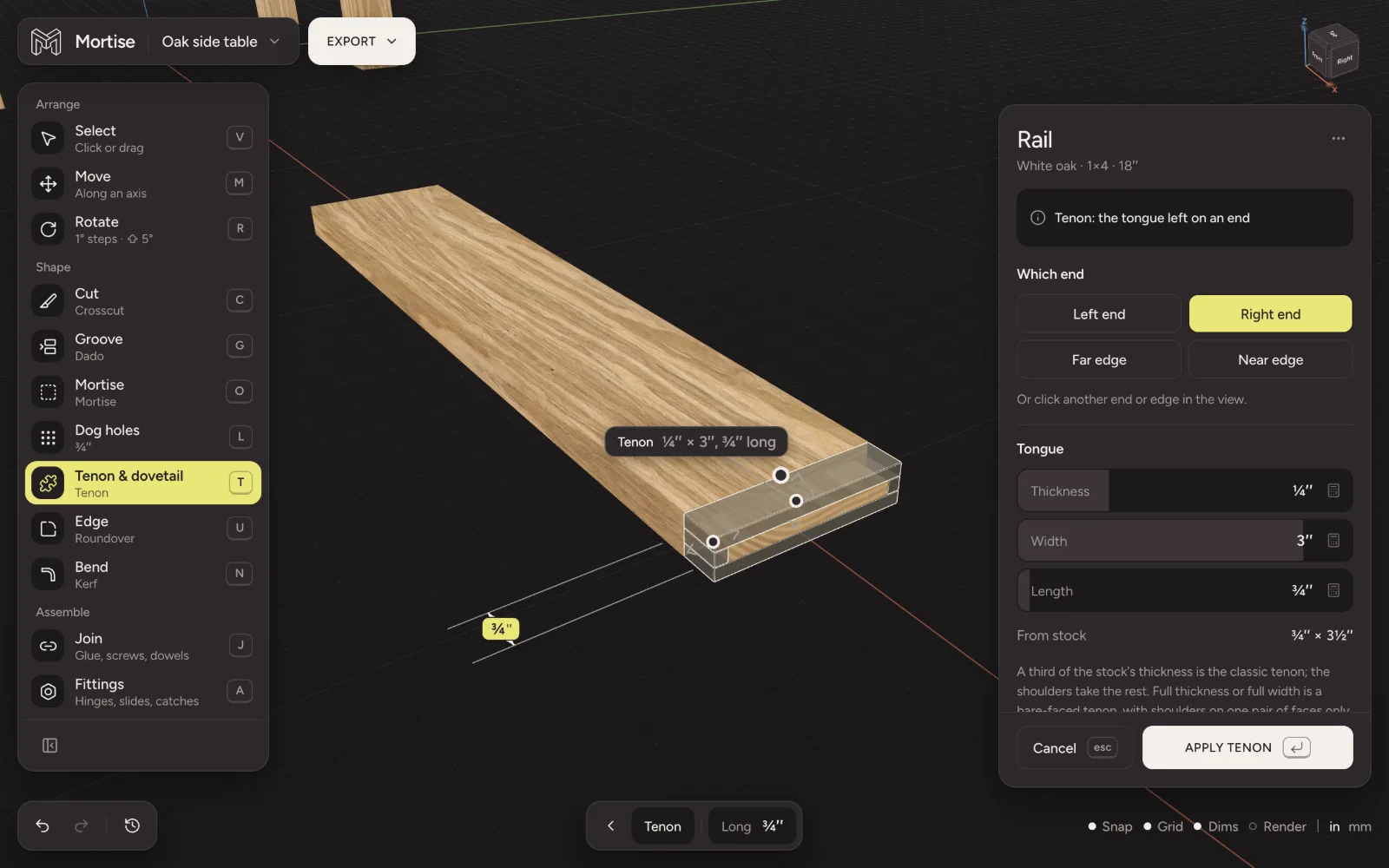
Drag the shoulder, thickness and width handles on the wood. On a board already shaped by an outline or a taper, the tenon centres on what is left of the end, not the original blank.
Box joint
Square fingers across the end. Set How many, the Depth (it starts at the mating board’s thickness) and whether to Start with a finger or a notch. The mating board starts the other way, so the two interlock.
Bridle joint
An open slot down the end, set by the Slot width and Depth. After a bridle, the tenon tool starts at a full-width tenon the slot’s size, for the other half.
Dovetails
- On the first board, pick Tails: they flare across the face. Set How many, the Pin width, the Depth and the Slope.
- On the second board, pick Pins: they narrow on the outside. They start matched to the tails you just cut; pick the Outside face.
- Slide the tail board onto the pins with Move, and glue the joint.
On a glue-up
An end joint can be cut across the end of a glued-up panel as one. Square the end of the glue-up first, so no board runs on past the others.
Questions
- Can Mortise cut dovetails?
- Yes, through dovetails: tails on one board and pins on the other, at 1:6, 1:7 or 1:8.
- Why can’t I cut both halves of a dovetail at once?
- A joint is cut on each board separately, as in the shop. The pins start out matched to the tails you cut last, so the second half takes one click.
- How long should a tenon be?
- Mortise starts at 1 inch (25 mm). A common rule is about two thirds of the leg’s width it goes into, and a third of the rail’s thickness for the tenon’s thickness.